

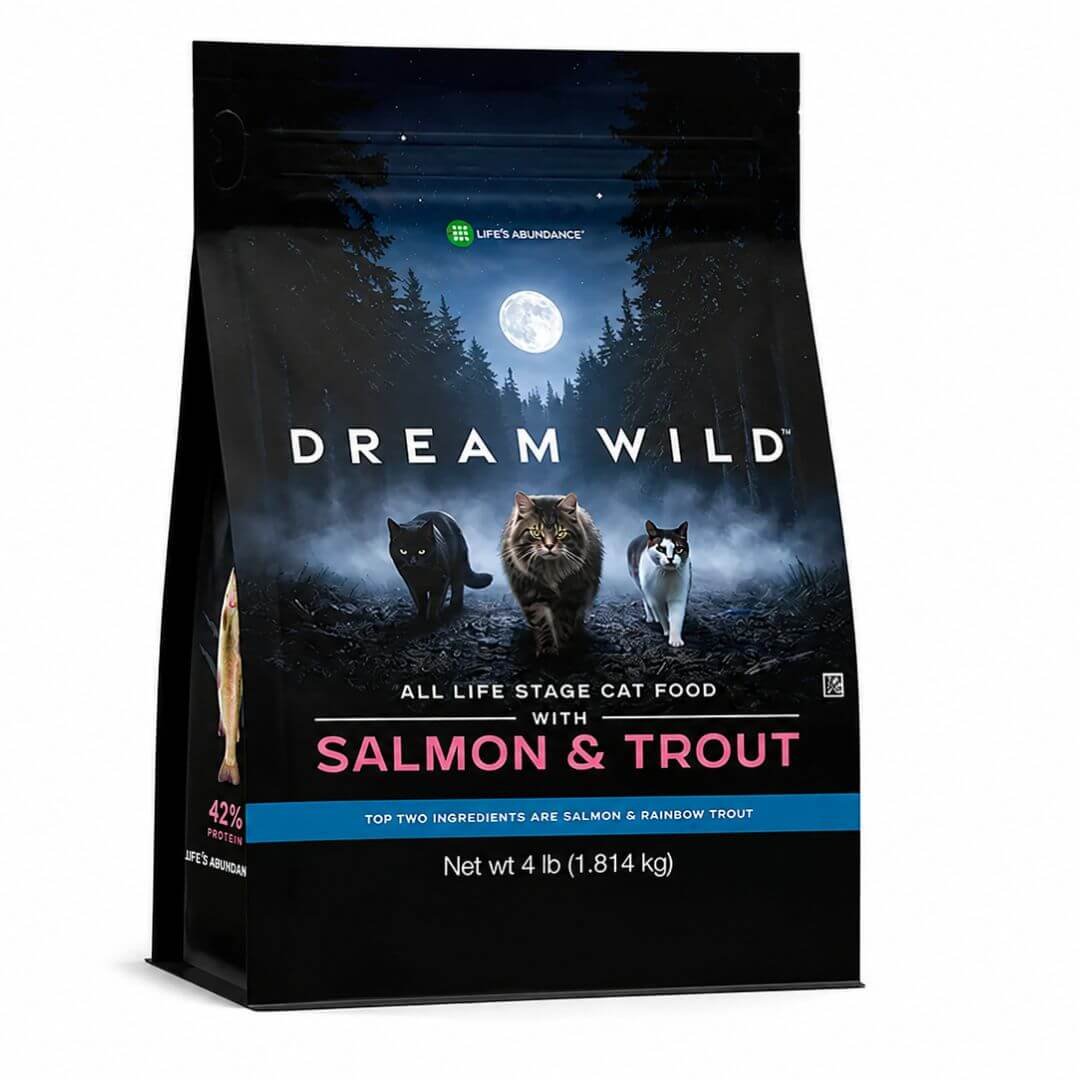
Dream Wild™ All Life Stage Cat Food Salmon & Trout
*Fish-forward recipe cats genuinely crave.
*Fresher than most bags on the shelf, shipped straight to your door.
*Made with safe, wholesome ingredients.
*Strict quality control. Every batch gets tested.
*NO RECALLS EVER.
*Made in the USA.
Description:
Good nutrition isn’t something you can see in your cat after one meal. It shows up over weeks, in a coat that looks healthier and energy that stays steady.
That’s why every number on this label matters, not just the ones printed in bold. Let’s have a closer look at what’s actually inside the bag and what each part does for your cat.
Nutrition Breakdown
Guaranteed Analysis
Numbers on a label can feel like a foreign language. Here’s what each one guarantees, and why it matters.
- Crude protein: 42.0% minimum. This fuels muscle, energy, and the day-to-day upkeep a cat’s body handles nonstop.
- Crude fat: 16.0% minimum. Fat delivers concentrated energy. It also supports a coat that stays soft and healthy.
- Crude fiber: 3.5% maximum. Fiber keeps digestion steady. Too much can crowd out other nutrients, so this stays capped.
- Moisture: 10.0% maximum. This is standard for dry food. It keeps the formula shelf-stable without added preservatives doing extra work.
- Omega-3 fatty acids: 1.0% minimum. These support skin, coat, joints, and heart function.
- Omega-6 fatty acids: 2.0% minimum. These work alongside omega-3s to support the skin barrier.
- Total microorganisms: minimum 10,000,000 CFU per pound. This measures the live probiotic content added for gut support.
Four probiotic strains make up that last number. They are L. casei, L. acidophilus, B. animalis, and L. reuteri. Each one supports a slightly different part of digestion, so together they cover more ground than a single strain could.
One thing worth knowing. AAFCO doesn’t classify omega fatty acids or microorganisms as essential nutrients on paper.
That doesn’t make them unimportant. It just means the guarantee goes beyond the bare minimum most labels are required to list.
What’s Inside the Bag
A full ingredient list can look intimidating at first glance. Reading it closely tells you a lot about how a formula is really built. Here it is in order:
Salmon, Rainbow Trout, Egg Product, Catfish Meal, Whitefish Meal, Herring Meal, Peas, Lentils, Tapioca, Salmon Meal, Canola Oil (Preserved with Mixed Tocopherols), Menhaden Fish Meal, Brewers Dried Yeast, Natural Flavor, Sweet Potato, Flaxseed, Tomato Pomace, Salt, Potassium Chloride, Cranberries, Blueberries, Taurine, Inulin, New Zealand Green Mussels, Potato, Pumpkin Meal, Carrots, Turmeric, Pomegranate, Broccoli, Mixed Tocopherols (Preservative), Choline Chloride, Calcium Carbonate, Vitamin E Supplement, Ferrous Sulfate, Zinc Sulfate, Zinc Proteinate, Iron Proteinate, Niacin, Copper Sulfate, Manganese Sulfate, Dried Kelp, Thiamine Mononitrate, d-Calcium Pantothenate, Pyridoxine Hydrochloride, Riboflavin Supplement, Manganese Proteinate, Vitamin A Supplement, Citric Acid, Copper Proteinate, L-Ascorbyl-2-Polyphosphate (Source of Vitamin C), Vitamin B12 Supplement, Vitamin D3 Supplement, Folic Acid, Sodium Selenite, Calcium Iodate, Biotin, and four fermentation products tied to the probiotic strains listed above.
Notice where the fish sits. Salmon and trout lead the list. That means they make up more of the recipe by weight than anything that follows.
The ingredients further down the list, like vitamins and minerals, appear in much smaller amounts. They round out the nutrition without changing what the food is built around.
Calories at a Glance
- Metabolizable energy: 3,721 kcal per kg
- Per cup: 465 kcal
This number matters most when portioning meals. A cat eating too many calories for their size can gain weight slowly without anyone noticing until it’s already happened. Knowing the calorie count per cup makes it easier to catch that early, especially for cats who don’t move around as much as they used to.
Built for Every Life Stage
This formula meets AAFCO Cat Food Nutrient Profiles for All Life Stages. That single detail covers kittens, adults, and senior cats under one label.
Most brands split their lineup by age. That means separate bags, separate transitions, and separate label reading every time a cat crosses into a new stage of life.
An all-life-stage formula removes that step entirely. It’s also useful in homes with more than one cat, where feeding times often overlap and separate bowls with separate foods get complicated fast.
How Much to Feed
Start with the amount below. Treat it as a starting point, not a fixed rule. Every cat burns energy a little differently, so adjust based on weight and body condition over time.
Kittens
- 1 to 5 lbs: 1/4 to 2/3 cup daily
- 5 to 10 lbs: 2/3 to 3/4 cup daily
- 10 to 15 lbs: 3/4 to 1 cup daily
- Over 15 lbs: add 1/4 cup for every 5 lbs of body weight
Adults
- 1 to 5 lbs: 1/5 to 1/2 cup daily
- 5 to 10 lbs: 1/2 to 2/3 cup daily
- 10 to 15 lbs: 2/3 to 3/4 cup daily
- Over 15 lbs: add 1/4 cup for every 5 lbs of body weight
A few extra tips worth keeping in mind:
- Split the daily amount into two or more meals, or free feed if your cat handles that well without overeating
- Free feeding works for some cats, but it can lead to weight gain in others, so keep an eye on body condition
- Keep fresh water available at all times, no matter which feeding method you choose


Reviews
There are no reviews yet.